EPDM vs. self-adhered flat roofing: which is right for your roof?
On this page · 8 sections
Flat roofs are everywhere in the Hudson Valley: over garage additions and back porches in Newburgh, on the rear sections of older homes in Poughkeepsie, and across whole commercial buildings from Middletown to Wappingers Falls. When one of them starts leaking, the first question we hear is usually some version of "what should it be redone with?" On our flat roof jobs, the answer almost always comes down to two systems we install: EPDM rubber and GAF self-adhered membrane.
Both are proven, both keep water out when they are installed right, and neither one is the "best" flat roof for every building. The right pick depends on four things: what the roof is shaped like, what sits on top of it, who walks on it, and what is already underneath. Work through those and the choice usually makes itself. Here is how we walk property owners through it.
The short answer
Bottom Line Up Front
If your flat roof is a simple, open surface that nobody walks on, EPDM rubber is usually the clean, straightforward choice. If it has lots of vents, pipes, and curbs, gets regular foot traffic, or sits where open flame is a concern, a GAF self-adhered system is usually the better fit.
Both systems keep water out when they go down over a dry, well-drained roof, and both are installed without a torch. The real differences are in how each one handles rooftop details, foot traffic, and repairs down the road. Get the drainage and the layers underneath right first; the membrane choice comes after.
The rest of this post explains what each system is, where each one earns its keep, and a decision matrix at the end that gets most people to the right answer in a couple of minutes.
What is EPDM, and where does it work best?
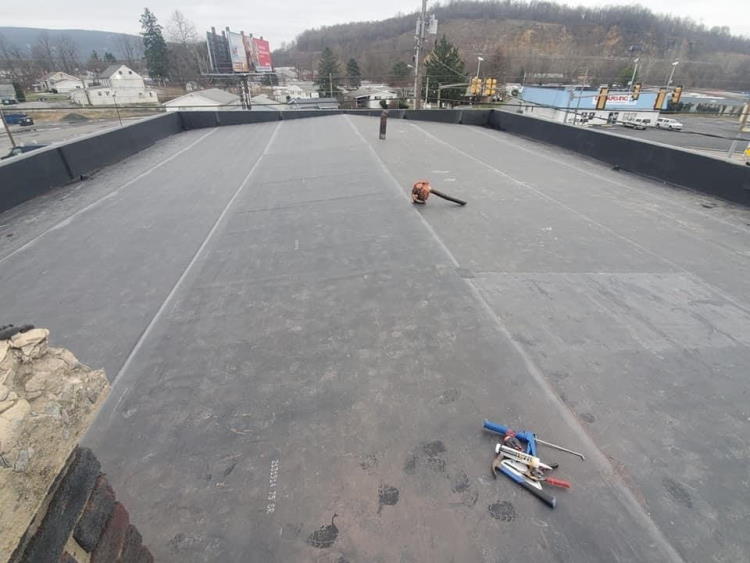
EPDM is a synthetic rubber membrane, the black "rubber roof" most people picture when they think of a flat roof. It goes down in large sheets, so a simple roof can be covered with very few seams, and the seams it does have are bonded with products made for the membrane. Rubber stays flexible in cold weather, which matters on a roof that freezes and thaws all winter long.
EPDM shines on open, uncomplicated roofs: a garage, a porch, or a low-slope addition with a chimney and not much else. It is also forgiving to repair. A puncture or a lifted seam on a sound EPDM roof can often be patched with compatible materials rather than torn off.
What is a GAF self-adhered system, and where does it work best?
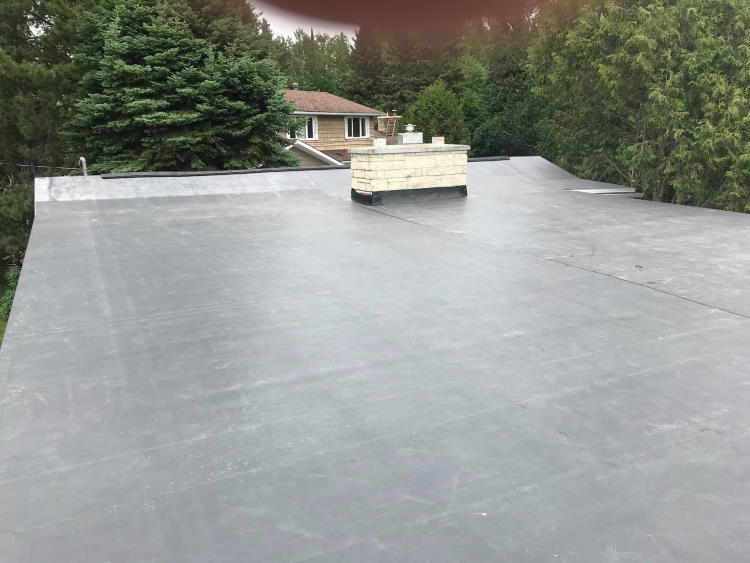
A self-adhered flat roof is exactly what it sounds like: membrane sheets with an adhesive backing that bond to the layer beneath them, typically installed as a base layer with a cap layer on top. There is no torch and no open flame, which is a real advantage when the roof sits over a lived-in house or a busy business.
Because the sheets are smaller and lap over one another, self-adhered systems are easy to work around vents, pipes, curbs, and other rooftop details. The cap layer gives the roof a tougher, textured surface that handles occasional foot traffic better than bare rubber does.
EPDM vs. self-adhered at a glance
This is the comparison we would sketch out for you on site. Each row is a real factor; the highlighted cell is the system that tends to come out ahead when that factor is the one driving your decision.
| Factor | EPDM (rubber) | GAF self-adhered |
|---|---|---|
| Roof shape | Open, simple surfaces | Lots of vents, pipes, and curbs |
| How it goes down | Large rubber sheets, bonded seams | Peel-and-stick layers that lap over each other |
| Open flame | None needed | None needed |
| Detail work | Doable, more careful detailing | Cuts and laps easily around details |
| Foot traffic | Best with walkway protection | Tougher, textured cap surface |
| Cold-weather flexibility | Stays flexible when it freezes | Bonds best when installed in mild weather |
| Future repairs | Patches easily with compatible materials | Patches with compatible membrane |
These are general characteristics of each system, not a spec sheet. Your roof likely matches more than one row — the right call is whichever column wins the most of your rows.
The easiest at-home check on any flat roof is to look at it a day or two after a good rain, from a window or the top of a ladder. A damp surface is normal. Puddles that are still sitting there are not. Standing water means the roof is not draining the way it should, and no membrane, EPDM or self-adhered, will last as long as it should while it sits underwater. Drainage gets fixed first.
What is going on top of your roof?
This is the question that most often tips the decision. A porch roof nobody ever steps on is a very different job from a commercial roof with HVAC units that get serviced every season. Every technician who walks across to a rooftop unit is a chance to drop a screw or drag a tool across the surface.
On a busy roof, we lean toward the tougher surface of a self-adhered system, or we plan walkway protection on EPDM along the paths people actually take. On a quiet roof with nothing on it, EPDM's simplicity is hard to beat. If you own a commercial building, our post on common commercial roofing systems goes deeper on the options for larger roofs.
Signs EPDM fits
A simple roof with little on it and few people walking across it.
What we look for
- The roof is a plain, open surface with a chimney or a vent or two and not much else.
- Nobody walks on it except to clear leaves or check on it now and then.
- The existing roof is already EPDM and the membrane is still sound around the leak.
- It covers a garage, porch, or small addition rather than a busy commercial roof.
Signs self-adhered fits
A roof with a lot going on, or one where people and equipment are on it regularly.
What changes the answer
- The roof is crowded with vents, pipes, skylights, curbs, or rooftop units.
- Technicians walk across it to service equipment several times a year.
- The roof sits over an occupied home or business where open flame is a concern.
- You want a textured, granulated surface instead of bare black rubber.
Repair, recover, or replace?
Not every flat roof leak means a new roof. If the existing membrane is sound and the problem is one seam, one flashing, or one puncture, a targeted repair is usually the honest answer, and you keep the system you already have.
The answer changes when water has gotten under the membrane. Wet insulation does not dry out on its own under a roof, and soft decking does not get firmer. When we find that, the wet layers come out before anything new goes down, and that is the point where choosing between EPDM and self-adhered becomes a real decision rather than a patch. That is a full replacement, and it is worth doing right once.
The most common flat roof "repair" we tear off is a thick smear of tar or roofing cement over a leak. On an EPDM roof it can do more harm than good, because asphalt-based products are not compatible with rubber membranes. It also hides the real failure, so the leak moves a few feet and comes back. If a flat roof is leaking, get the cause found and fixed with materials made for that membrane.
“We don’t pick the membrane first. We look at the roof, what sits on it, and who walks on it, and the membrane picks itself.”— Xterior PRO Roofing & Siding, LLC
The decision matrix
If you only use one part of this post, use this table. Find the rows that describe your roof and see which column has the stronger answer. Most roofs match more than one row; the right pick is whichever column wins the most of your rows.
| If your flat roof… | EPDM | Self-adhered |
|---|---|---|
| Is a simple, open surface | Great fit | Works well |
| Has lots of vents, pipes, or curbs | More detailing | Good fit |
| Gets regular foot traffic | Add walkway protection | Tougher surface |
| Sits over an occupied space | No torch | No torch |
| Is EPDM now with one bad seam | Repair it | Overkill |
| Holds water days after a rain | Fix drainage first | Fix drainage first |
| Has wet insulation underneath | After wet layers come out | After wet layers come out |
The bottom line
EPDM and GAF self-adhered are both solid flat roof systems, and we install both because neither is right for every roof. Simple, quiet roofs tend to suit EPDM. Roofs with lots of details, regular foot traffic, or a need to avoid open flame tend to suit self-adhered. Either way, the membrane only lasts if the drainage works and the layers underneath are dry.
If you are not sure which way your roof leans, that is what a free inspection is for. We will look at the surface, the details, and what is underneath, then tell you whether it needs a repair or a new system and which one fits. You can also browse our recent projects, check our financing options, or call us at 845-549-2069 to set up a visit.